










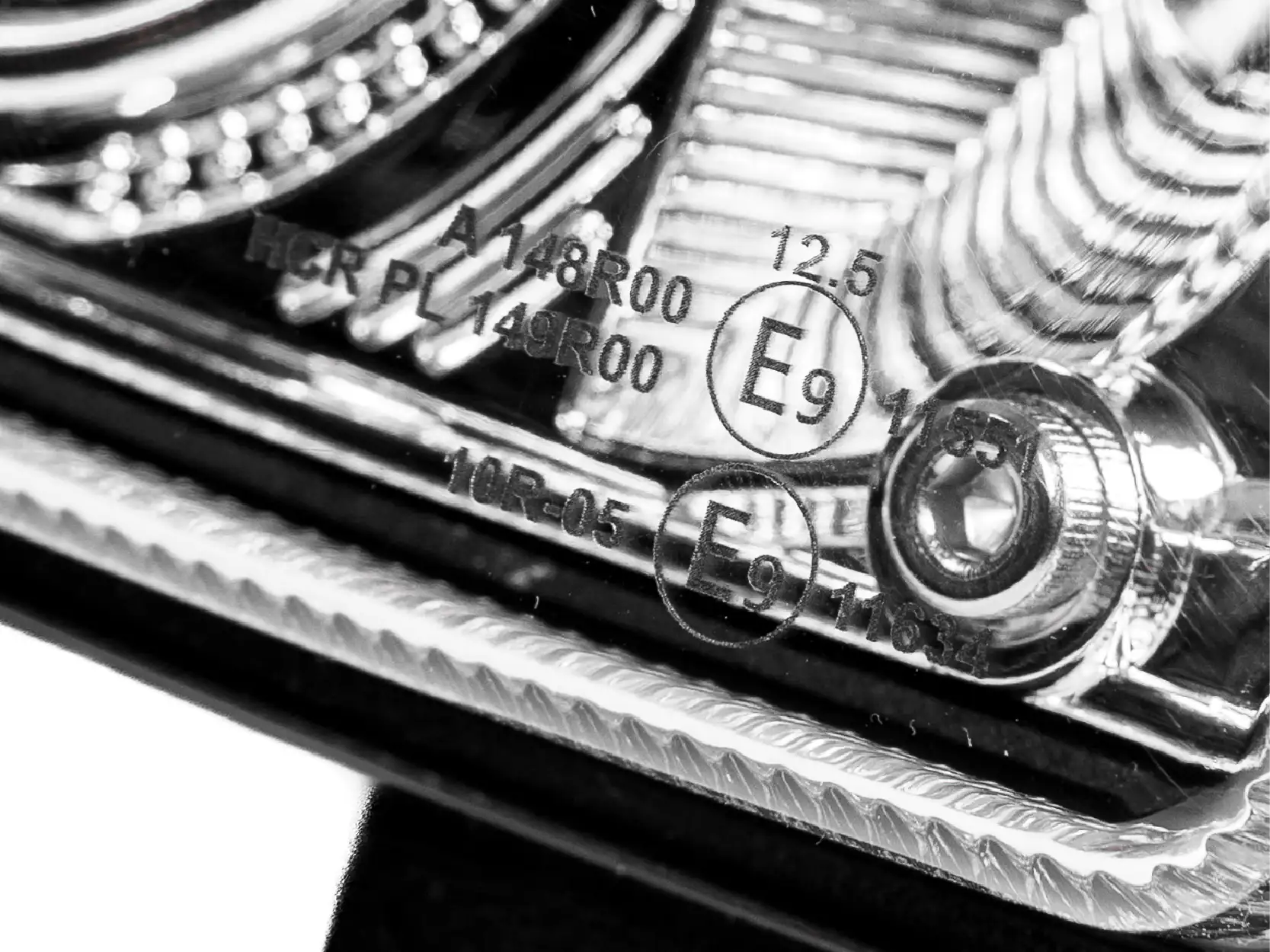
What Do the Codes on Lamps Mean? E-Markings and R-Codes Explained
Anyone reviewing the specifications of a work light, headlight, or other vehicle lighting will encounter a range of letters and numbers on the lens or housing. Codes such as E-marking, R10, R149, HCR or PL appear regularly. Understanding what these markings mean is essential for dealers and technical staff when specifying products, advising customers, or verifying road legality.
This article provides a clear and practical explanation of each code, so the relevant information can be read directly from a lamp’s markings.
Quick overview:
- The E-marking confirms that a lamp has been approved under European vehicle lighting regulations
- The number after the E indicates the country in which the approval was granted
- R-codes indicate which regulation a lamp has been tested under and what it is approved for
- R10 relates to electromagnetic compatibility (EMC)
- R148 and R149 relate to different categories of vehicle lighting
- HC, HR and HCR indicate which functions a headlight has, such as low beam and high beam
- The reference number provides information about the intensity of the high beam
- PL indicates that the lens is made of plastic
What Is the E-Marking?
The most important marking on vehicle lighting is the E-marking. It appears as an E inside a circle or rectangle, followed by a number.
The letter E confirms that the lamp has been tested and approved under European vehicle lighting regulations. The number indicates the country in which the approval was carried out. For practical purposes, the country of approval makes no difference: a lamp carrying an E-marking may be used throughout the European Union.
The E-marking is the official confirmation that a lamp meets European requirements for use on public roads.
E-Number Overview: Country of Approval
| E-number | Country of approval |
|---|---|
| E1 | Germany |
| E2 | France |
| E3 | Italy |
| E4 | Netherlands |
| E5 | Sweden |
| E6 | Belgium |
| E7 | Hungary |
| E8 | Czech Republic |
| E9 | Spain |
| E11 | United Kingdom |
| E12 | Austria |
| E13 | Luxembourg |
| E14 | Switzerland |
What Is an R-Code?
Alongside the E-marking, a lamp will typically carry a code containing the letter R, such as 10R06 or 149R00. The R-code indicates which regulation the lamp has been tested under and what it is approved for.
The digits before the R refer to the European regulation number, indicating the category of lighting. The letter R stands for Regulation. The two digits directly after the R indicate which version of the regulation was used during testing. The higher this number, the more recent the requirements against which the lamp was tested.
Following this code is a longer number: the unique approval number assigned to that specific lamp model by the testing authority. This allows the approval to be traced back to the exact test and model.
Reading an R-Code: A Practical Example
Take the code 10R06 22407:
- 10 — the lamp falls under regulation R10, meaning it has been tested for electromagnetic safety and must not cause interference to vehicle systems such as radio, electronics, or airbag systems
- R — the lamp is approved under European regulation
- 06 — the lamp was tested against version 06 of this regulation
- 22407 — the unique approval number for this specific lamp model
The Most Important R-Codes Explained
R10 — Electromagnetic Compatibility
R10 means a lamp has been tested for electromagnetic compatibility (EMC). It must not cause interference to the electronic systems of the vehicle, including airbag systems, on-board computers, radio and DAB reception, GPS, or ISOBUS. For work lights, R10 is typically the only mandatory certification, as these lamps are not classified as road lighting but must operate safely alongside vehicle electronics.
R148 — Signal Lighting
R148 covers lamps used for signalling functions, including indicators, position lights, brake lights, daytime running lights, reversing lights, and rear fog lights. This regulation replaced a number of older individual regulations (R4, R6, R7, R23, R38, R87, R91 and others).
R149 — Road Lighting
R149 applies to lamps intended for use on public roads that illuminate the road ahead of the vehicle. This includes front fog lights, low beam (both symmetrical and asymmetrical), high beam, and cornering lights. R149 replaced a number of older regulations including R112 and R113. A lamp carrying R149 approval is certified for use as road lighting during driving on public roads.
R-Code Regulation Overview
Signal Lighting
| Previous code | Current code | Application |
|---|---|---|
| R4 | R148 | Rear number plate lighting |
| R6 | R148 | Indicators / direction signals |
| R7 | R148 | Front and rear position lights, brake lights and contour lights |
| R23 | R148 | Reversing lights |
| R38 | R148 | Rear fog lights |
| R87 | R148 | Daytime running lights (DRL) |
| R91 | R148 | Side marker lights |
Road Lighting
| Previous code | Current code | Application |
|---|---|---|
| R19 | R149 | Front fog lights |
| R112 | R149 | Headlights with asymmetric low or high beam |
| R113 | R149 | Headlights with symmetric low or high beam |
| R119 | R149 | Cornering lights |
| R123 | R149 | Adaptive front lighting systems |
Beam Function Codes: HC, HR, HCR and HC/R
In addition to the E-marking and R-code, headlights may carry codes such as HC, HR, HCR or HC/R. These indicate which light function the headlight provides.
| Code | Meaning | Description |
|---|---|---|
| HC | Low beam only | Approved for low beam for standard driving |
| HR | High beam only | Approved for high beam for maximum illumination |
| HCR | Low beam and high beam | Both functions can be used simultaneously |
| HC/R | Low beam or high beam | Functions cannot be used simultaneously |
The Reference Number: High Beam Intensity
Close to the E-marking, a two-digit number is often present, such as 12, 15 or 45. This is the reference number, indicating the intensity of the high beam. It can be understood as a light value showing how much a lamp contributes to the total high beam intensity of the vehicle.
European regulations specify that the combined reference number of all high beam lamps on a single vehicle must not exceed 100. This includes both standard headlights and any additional spotlights or supplementary high beam lamps mounted on the vehicle.
When a vehicle carries multiple high beam sources, all reference numbers are added together. For example:
- Standard headlight left: 15
- Standard headlight right: 15
- Additional spotlight left: 45
- Additional spotlight right: 45
- Total: 15 + 15 + 45 + 45 = 120 — above the permitted limit of 100 and therefore not road-legal
This regulation exists to prevent vehicles from emitting excessively bright light that could dazzle other road users.
PL: Plastic Lens
The letters PL on a lamp indicate that the lens is made of plastic. PL stands for Plastic Lens. Modern lamps use high-grade plastic rather than glass as standard. Plastic is lighter, more resistant to stone impact and better suited to the vibration and intensive use typical of agricultural vehicles.
What This Means in Practice
All markings on a lamp indicate whether it is road-legal, what it is approved for, and whether it operates safely alongside the vehicle’s electronics. Understanding these codes allows dealers to specify products correctly, verify compliance, and advise customers with confidence.
All CRAWER products carry the relevant certifications for their intended application. Full certification details are available on each product page and in the technical documentation. For specification support or compliance questions, contact your CRAWER account manager.
